Curriculum

What students learn, unit by unit.

Every unit in order, and what a student can do after each one. Three levels are built; Level 4 arrives in January 2027.

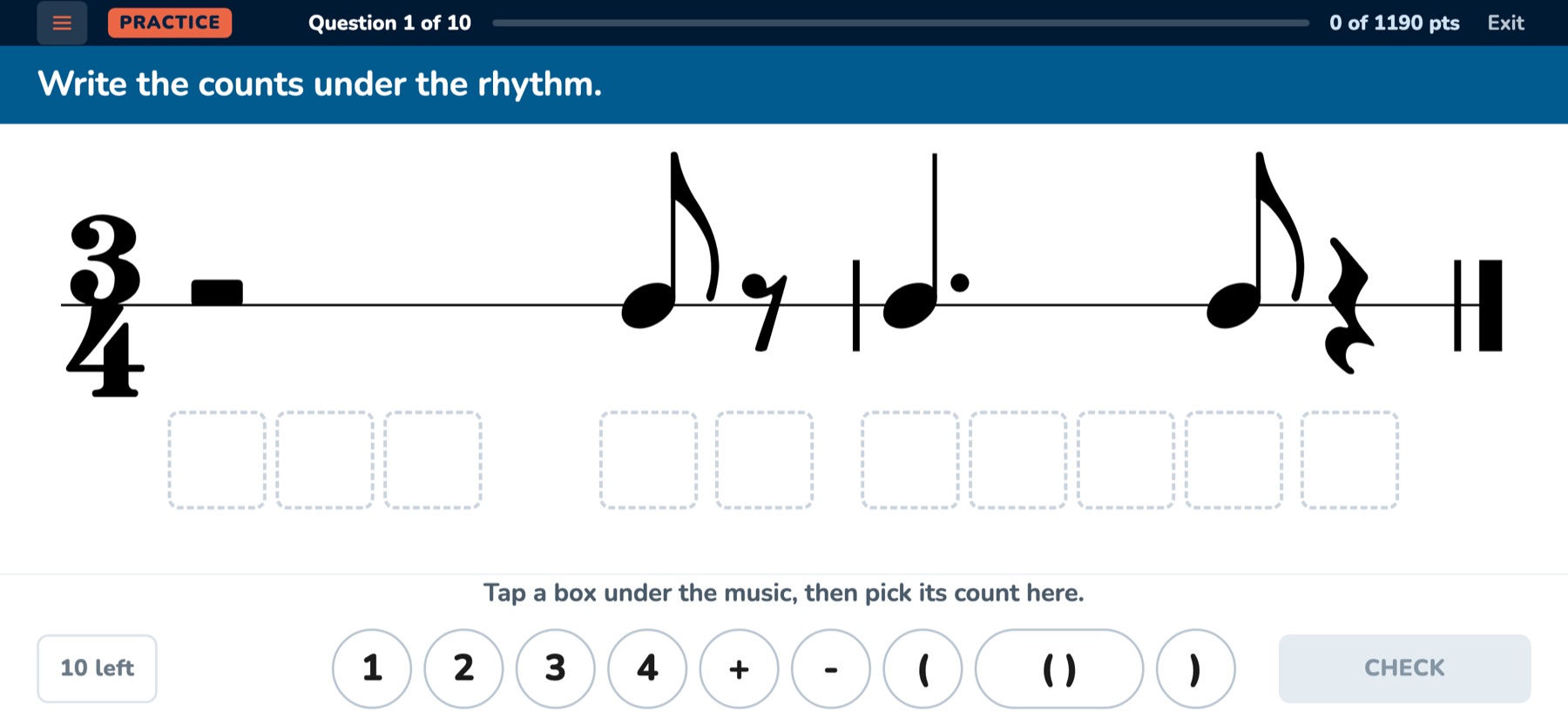
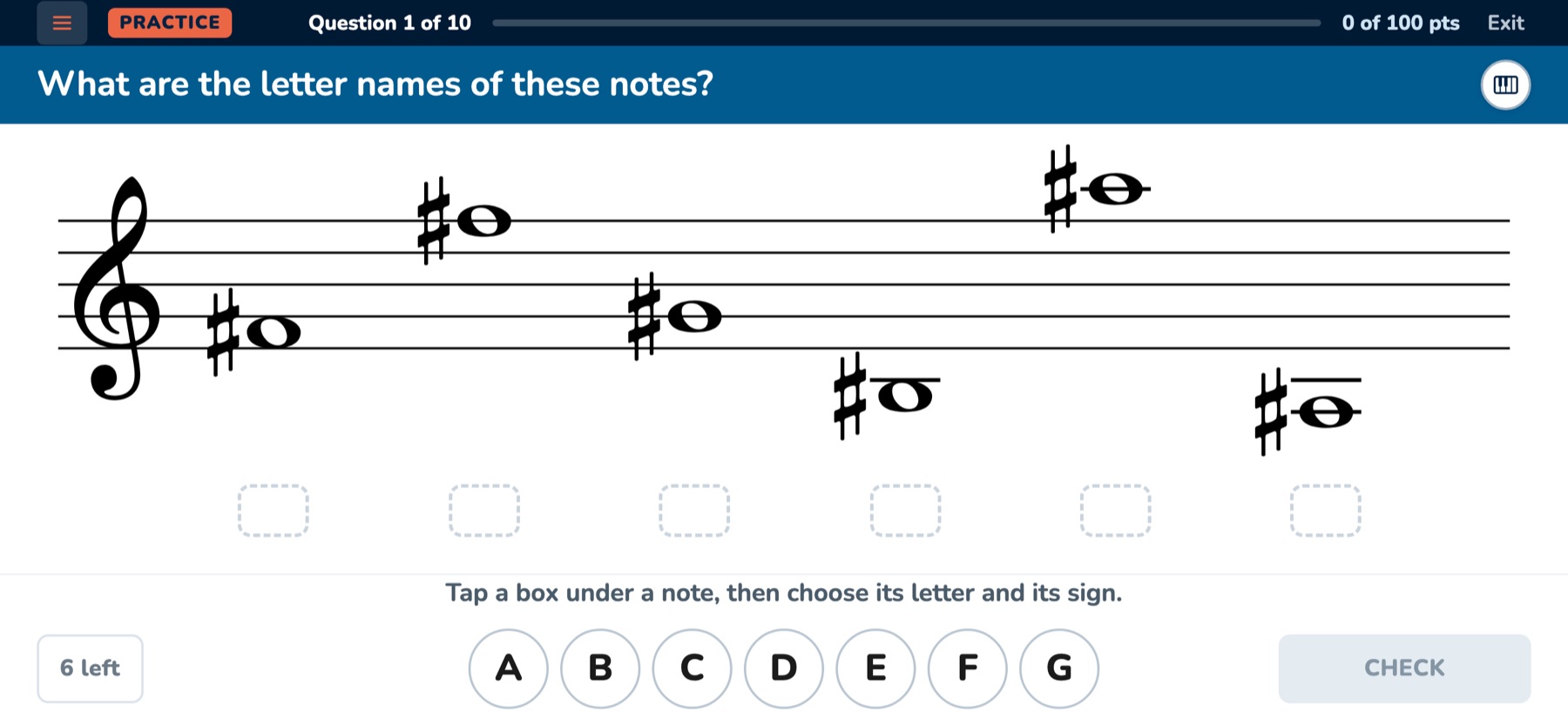
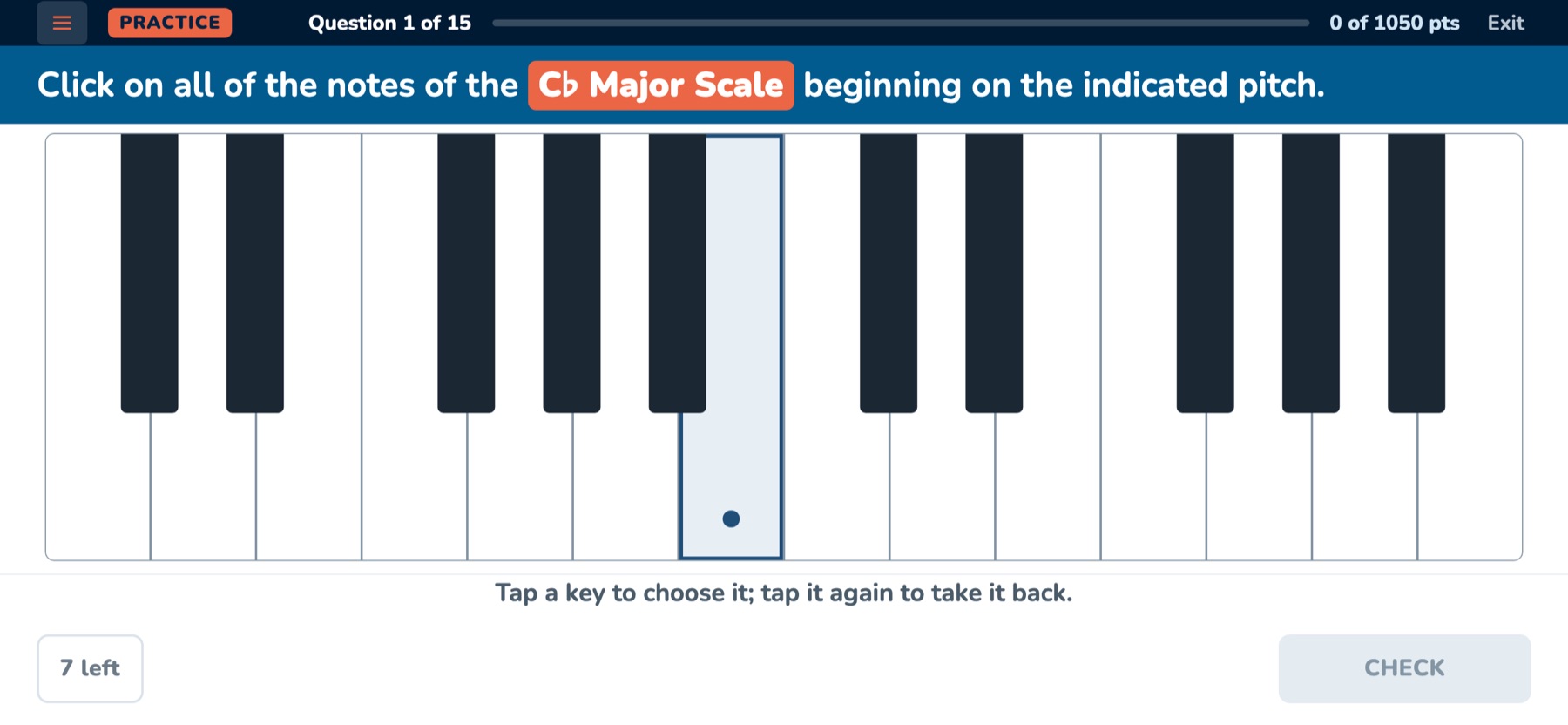
A counting question: write the counts under the rhythm A question on the staff: name the notes A keyboard question: the notes of a major scale on the keys
Theory Level 1Level 116 units, 3 midterms and a final exam

Unit 1.1

The Staff

  • I can tell whether a place on the staff is a line or a space.
  • I can say which line a marked place is.
  • I can say which space a marked place is.
  • I can find a named line or space on the staff.
  • I know the staff has five lines and four spaces, numbered from the bottom up.

Unit 1.2

Pitch

  • I can say what pitch means.
  • I know that pitch is shown on the staff by notes.
  • I can find the highest or the lowest of several pitches written on the staff.
  • I can tell which pitch I hear is the highest or the lowest.

Unit 1.3

Time Signatures and Measures

  • I can say what a measure is.
  • I can count the measures in a line of music.
  • I can say what bar lines and double bar lines are.
  • I can point out the bar lines and the double bar line on a staff.
  • I can say what a time signature is.
  • I can work out how many beats are in each measure from the time signature.

Unit 1.4

Notes

  • I can recognize a whole note and say how many beats it lasts.
  • I can recognize a half note and say how many beats it lasts.
  • I can recognize a quarter note and say how many beats it lasts.
  • I can point out the notehead and the stem of a note.
  • I can work out which way a note’s stem should point.

Unit 1.5

Counting Notes

  • I can count quarter notes: each one gets one beat.
  • I can count half notes: two beats, written as two counts joined by a dash.
  • I can count whole notes: four beats, written as four counts joined by dashes.
  • I can write the counts under a rhythm of whole, half and quarter notes in 4/4, 3/4 and 2/4.
  • I can build a rhythm from its counts.
  • I can pick out the rhythm I hear and build it.

Unit 1.6

Rests

  • I can pick out a whole rest and say how long it lasts: the whole measure, in any time signature.
  • I can pick out a half rest and say how long it lasts: two beats.
  • I can pick out a quarter rest and say how long it lasts: one beat.
  • I can say where a whole rest goes: it hangs below the fourth line.
  • I can say where a half rest goes: it sits on top of the third line.

Unit 1.7

Counting Rests

  • I can count quarter rests: each one is one beat of silence, and its count goes in parentheses.
  • I can count half rests: two beats of silence, written as one count in parentheses.
  • I can count a whole rest: it empties the measure, however many beats that measure holds, and a rest that fills the measure is always written that way.
  • I can write the counts under a rhythm of whole, half and quarter rests in 4/4, 3/4 and 2/4.
  • I can build a rhythm of rests from its counts.

Unit 1.8

Combining Notes and Rests

  • I can count quarter notes and quarter rests together: each is one beat, and a rest’s count goes in parentheses.
  • I can count half notes and half rests: two beats each, with a half rest’s two counts inside one pair of parentheses.
  • I can count whole notes and whole rests: a whole rest empties any measure, and a whole note fits only a measure of four.
  • I can write the counts under a rhythm of whole, half and quarter notes and rests in 4/4, 3/4 and 2/4.
  • I can build a rhythm of notes and rests from its counts.
  • I can pick out a rhythm of notes and rests that I hear and build it.

MidtermUnit 1.9

Midterm 1

Covers Units 1.1 to 1.8

Unit 1.10

Treble Clef Lines

  • I can name the line notes of the treble clef: E, G, B, D, F.
  • I can write the line notes of the treble clef on the staff.
  • I know the treble clef, the G clef, the music alphabet and Every good boy does fine.

Unit 1.11

Treble Clef Spaces

  • I can name the space notes of the treble clef: F, A, C, E.
  • I can write the space notes of the treble clef on the staff.
  • I know the treble clef, the four spaces counted from the bottom up, and F A C E.

Unit 1.12

Combining Treble Clef Lines and Spaces

  • I can name every note on the treble staff, lines and spaces.
  • I can write every note of the treble staff, lines and spaces, on the staff.
  • I know that lines and spaces take turns going up, and the nine notes of the treble staff, E to F.

Unit 1.13

Treble Clef Ledger Lines

  • I can name the notes above and below the treble staff, on and between ledger lines.
  • I can write the notes above and below the treble staff, on and between ledger lines.
  • I know ledger lines, middle C, and the sentences for the notes above and below the treble staff.

MidtermUnit 1.14

Midterm 2

Covers Units 1.10 to 1.13

Unit 1.15

Bass Clef Lines

  • I can name the line notes of the bass clef: G, B, D, F, A.
  • I can write the line notes of the bass clef on the staff.
  • I know the bass clef, the F clef, its two dots on F, and Good boys do fine always.

Unit 1.16

Bass Clef Spaces

  • I can name the space notes of the bass clef: A, C, E, G.
  • I can write the space notes of the bass clef on the staff.
  • I know the bass clef, the four spaces counted from the bottom up, and All cows eat grass.

Unit 1.17

Combining Bass Clef Lines and Spaces

  • I can name every note on the bass staff, lines and spaces.
  • I can write every note of the bass staff, lines and spaces, on the staff.
  • I know that lines and spaces take turns going up, and the nine notes of the bass staff, G to A.

Unit 1.18

Bass Clef Ledger Lines

  • I can name the notes above and below the bass staff, on and between ledger lines.
  • I can write the notes above and below the bass staff, on and between ledger lines.
  • I know ledger lines, middle C, and the sentences for the notes above and below the bass staff.

MidtermUnit 1.19

Midterm 3

Covers Units 1.15 to 1.18

Final examUnit 1.20

Level 1 Final Exam

Covers the whole level, Units 1.1 to 1.19

Theory Level 2Level 216 units, 3 midterms and a final exam

Unit 2.1

Eighth Notes and Rests

  • I can recognize an eighth note and an eighth rest and say how long each lasts: half a beat.
  • I can say how many eighth notes fill a quarter, a half or a whole note, and the same for the rests.
  • I can name the parts of a note: the notehead, the stem, the flag and the beam.
  • I can work out which way an eighth note’s stem and flag, or a beamed group, should point.

Unit 2.2

Counting Eighth Notes and Rests

  • I can count eighth notes: one and two and, written 1 + 2 +.
  • I can count eighth rests in parentheses: (1) on the beat, (+) off it.
  • I can write the counts under a rhythm with eighth notes and rests.
  • I can build a rhythm with eighths from its counts.
  • I can pick out a rhythm with eighths that I hear and build it.

Unit 2.3

Combining All Notes and Rests

  • I can say how the notes and rests compare: one whole equals two halves, four quarters, eight eighths.
  • I can count notes and rests together in 4/4, 3/4 and 2/4, eighths included.
  • I can build a rhythm of notes and rests from its counts.
  • I can pick out a rhythm of notes and rests that I hear and build it.

Unit 2.4

Understanding Dotted Rhythms

  • I can say how much a dot adds to a note: half of its value.
  • I can give the beats of a dotted whole, dotted half, dotted quarter and dotted eighth note.
  • I can say which dotted note fills a measure, and what fills it beside one.

Unit 2.5

Dotted Half Notes

  • I can count a dotted half note: one-two-three, or two-three-four, from the beat where it starts.
  • I can count dotted half notes with rests and eighths in 4/4 and 3/4.
  • I can build a rhythm with dotted half notes from its counts.
  • I can pick out a rhythm with dotted half notes that I hear.

Unit 2.6

Dotted Quarter Notes

  • I can count a dotted quarter note on the beat (1 - 2) and on the and (+ 2 -).
  • I can count dotted quarter notes with eighths in 4/4 and 3/4.
  • I can build a rhythm with dotted quarter notes from its counts.
  • I can pick out a rhythm with dotted quarter notes that I hear.

Unit 2.7

Ties

  • I can say what a tie does: it joins notes of the same pitch into one sound, as long as all of them together.
  • I can add up the beats of tied notes.
  • I can count tied notes with dashes, across the bar line and inside a measure.
  • I can say when a tie and a dot make the same sound.

MidtermUnit 2.8

Level 2 Midterm 1

Covers Units 2.1 to 2.7

Unit 2.9

Dynamics: Loud and Soft

  • I can name the six dynamic markings and say what each means: pp, p, mp, mf, f, ff.
  • I can put the six dynamics in order from softest to loudest.
  • I can say what mezzo and issimo add to piano and forte.
  • I can hear whether music gets louder or softer.

Unit 2.10

Dynamics: Louder and Softer

  • I can recognize a crescendo and a decrescendo, as signs and as words, and say what each means.
  • I can say that diminuendo (dim.) means the same as decrescendo.
  • I can find the crescendos and decrescendos in a piece of music.
  • I can hear whether the volume changes gradually or all at once.

Unit 2.11

Articulation: Long and Short

  • I can say what articulation is.
  • I can recognize legato and the slur, and staccato and its dot, and say what each means.
  • I can tell a slur from a tie.
  • I can find every slur, tie and staccato note in a piece of music.
  • I can hear whether notes are played smooth or short.

Unit 2.12

Articulation: Other Markings

  • I can recognize a fermata, an accent, a tenuto, a caesura and a breath mark, and say what each means.
  • I can tell an accent from a decrescendo.
  • I can find a marking in a piece of music.
  • I can hear whether a note holds or the music stops.

Unit 2.13

Tempo: Faster and Slower

  • I can say what tempo is and read a tempo marking in beats per minute.
  • I can say which note gets the beat from the bottom number: 2, 4 or 8.
  • I can say what ritardando, accelerando and a tempo mean.
  • I can hear whether the music speeds up or slows down.

Unit 2.14

Tempo: Other Tempos

  • I can say what each of the ten tempo words means.
  • I can put the ten tempo words in order from slowest to fastest.
  • I can say which of two tempo words is faster.
  • I can hear which of two tempo words a piece is played at.

MidtermUnit 2.15

Level 2 Midterm 2

Covers Units 2.9 to 2.14

Unit 2.16

Measures and Bar Lines

  • I can name a bar line, a measure, a double bar line and a final double bar line, and say what each marks.
  • I can work out how many beats a multi-measure rest stands for.
  • I can say which measure comes in after a multi-measure rest.

Unit 2.17

Repeats and Other Endings

  • I can recognize an end and a start repeat sign and say where each sends me.
  • I can follow first and second endings.
  • I can recognize a measure repeat sign and say what an ostinato is.
  • I can recognize a pickup measure and say which measure is measure one.

Unit 2.18

Road Signs and Reading a Score

  • I can follow D.C., D.S., al Fine and al Coda through a piece of music.
  • I can recognize the segno, the coda sign, Fine and To Coda.
  • I can name the four voices of a choir and tell an open score from a close score.
  • I can say what a system, a brace, a bracket and a rehearsal mark are.

MidtermUnit 2.19

Level 2 Midterm 3

Covers Units 2.16 to 2.18

Final examUnit 2.20

Level 2 Final Exam

Covers the whole level, Units 2.1 to 2.19

Theory Level 3Level 316 units, 3 midterms and a final exam

Unit 3.1

The Piano Keyboard

  • I can find the groups of two and three black keys, all along the keyboard.
  • I can name any white key from where it sits beside the black keys.
  • I can find every key of the same letter: the pattern starts again at each one.

Unit 3.2

Whole and Half Steps

  • I can find the key a half step above or below any key.
  • I can find the key a whole step above or below any key.
  • I can tell a half step from a whole step.
  • I can count the half steps and the whole steps between two keys.

Unit 3.3

Sharps and Flats

  • I can find any sharp: one key to the right of its letter.
  • I can find any flat: one key to the left of its letter.
  • I can give both names of a key.
  • I can find a half step or a whole step from a named note.

Unit 3.4

Treble Clef Notes with Sharps and Flats

  • I can name a note with a sharp or a flat, on the staff and above and below it.
  • I can write a note with a sharp or a flat.
  • I can find a note with a sharp or a flat on the keyboard.
  • I can tell two names of the same pitch.
  • I can read a natural sign.

Unit 3.5

Bass Clef Notes with Sharps and Flats

  • I can name a note with a sharp or a flat, on the staff and above and below it.
  • I can write a note with a sharp or a flat.
  • I can find a note with a sharp or a flat on the keyboard.
  • I can tell two names of the same pitch.
  • I can read a natural sign.

MidtermUnit 3.6

Level 3 Midterm 1

Covers Units 3.1 to 3.5

Unit 3.7

The Major Scale

  • I can say what a scale is: every letter once, from the tonic up to the next one of the same name.
  • I can give the pattern of a major scale: whole, whole, half, whole, whole, whole, half.
  • I can build a major scale on any note: on the keys, on the staff, and with its sharps or flats.
  • I can tell an ascending scale from a descending one, by eye and by ear.
  • I can name a major scale from its keys, with both names where the keys make two.
  • I can hear a note of a scale that is not played as written.

Unit 3.8

Major Key Signatures with Sharps

  • I can say what an accidental is and what a key signature does.
  • I can write the sharps of a key signature in their order: F, C, G, D, A, E, B.
  • I can name a major key from its sharps: a half step above the last sharp.
  • I can place the major keys with sharps on the circle of fifths.

Unit 3.9

Major Key Signatures with Flats

  • I can say what an accidental is and what a key signature does.
  • I can write the flats of a key signature in their order: B, E, A, D, G, C, F.
  • I can name a major key from its flats: the next-to-last flat, and F Major for one flat.
  • I can place the major keys with flats on the circle of fifths.

Unit 3.10

The Natural Minor Scale

  • I can say what a natural minor scale is, and how it sounds beside a major one.
  • I can give the pattern of a natural minor scale: whole, half, whole, whole, half, whole, whole.
  • I can build a natural minor scale on any note: on the keys, on the staff, and with its sharps or flats.
  • I can tell an ascending scale from a descending one, by eye and by ear.
  • I can name a natural minor scale from its keys, with both names where the keys make two.
  • I can hear whether a scale is major or natural minor, and which note is not played as written.
  • I can find the relative minor of a major key.

Unit 3.11

Minor Key Signatures with Sharps

  • I can say what an accidental is, and that a minor key shares its relative major’s key signature.
  • I can name a minor key from its sharps: the major a half step above the last sharp, then three letters down.
  • I can find the relative minor of each major key with sharps.
  • I can write a minor key’s sharps in their order.
  • I can place the minor keys with sharps on the circle of fifths.

Unit 3.12

Minor Key Signatures with Flats

  • I can say what an accidental is, and that a minor key shares its relative major’s key signature.
  • I can name a minor key from its flats: the major is the next-to-last flat, then three letters down.
  • I can find the relative minor of each major key with flats.
  • I can write a minor key’s flats in their order.
  • I can place the minor keys with flats on the circle of fifths.

MidtermUnit 3.13

Level 3 Midterm 2

Covers Units 3.7 to 3.12

Unit 3.14

Generic Intervals

  • I can say what an interval is: the distance between two notes, counted from the first note as 1.
  • I can tell a melodic interval from a harmonic one, by eye and by ear.
  • I can name the number of an interval, melodic or harmonic: unison, 2nd, 3rd, 4th, 5th, 6th, 7th or octave.
  • I can find the line or space a 2nd, 3rd, 4th, 5th, 6th, 7th or octave above or below a note.
  • I can hear whether an interval goes up, down or stays the same, which number it is, and which of two is wider.

Unit 3.15

Major and Minor 2nds

  • I can tell a Major 2nd from a minor 2nd by its half steps: two make a Major 2nd, one a minor 2nd.
  • I can name a 2nd, melodic or harmonic, on the treble or the bass staff, with its sharps and flats.
  • I can hear a Major 2nd and a minor 2nd and tell them apart.
  • I can write a Major or minor 2nd above a note, with its sign.

Unit 3.16

Major and Minor 3rds

  • I can tell a Major 3rd from a minor 3rd by its half steps: four make a Major 3rd, three a minor 3rd.
  • I can name a 3rd, melodic or harmonic, on the treble or the bass staff, with its sharps and flats.
  • I can hear a Major 3rd and a minor 3rd and tell them apart.
  • I can write a Major or minor 3rd above a note, with its sign.

Unit 3.17

Perfect Intervals

  • I can say which intervals are Perfect (unison, 4th, 5th and octave) and which are Major or minor (2nds and 3rds).
  • I can name a Perfect 4th, 5th and octave, melodic or harmonic, on either staff, by their half steps: 5, 7 and 12.
  • I can hear a Perfect 4th, a Perfect 5th and an octave and tell them apart.
  • I can write a Perfect 4th, 5th or octave above a note, with its sign.

Unit 3.18

Major and Minor 6ths and 7ths

  • I can tell a Major 6th from a minor 6th, and a Major 7th from a minor 7th, by their half steps: 9 and 8, 11 and 10.
  • I can name a 6th or a 7th, melodic or harmonic, on either staff, with its sharps and flats.
  • I can hear Major and minor 6ths and 7ths and tell them apart.
  • I can write a Major or minor 6th or 7th above a note, with its sign.

MidtermUnit 3.19

Level 3 Midterm 3

Covers Units 3.14 to 3.18

Final examUnit 3.20

Level 3 Final Exam

Covers the whole level, Units 3.1 to 3.19

Theory Level 4Level 4Arriving January 202716 units, 3 midterms and a final exam
  1. 4.1Sixteenth Notes and Rests
  2. 4.2Counting Sixteenth Notes
  3. 4.3Dotted Eighth Notes
  4. 4.4Triplets
  5. 4.5Compound Meter
  6. 4.6Common Time and Cut Time
  7. 4.7Level 4 Midterm 1Midterm
  8. 4.8The Grand Staff
  9. 4.9Harmonic and Melodic Minor Scales
  10. 4.10The Chromatic Scale
  11. 4.11Scale Degrees
  12. 4.12Augmented and Diminished Intervals
  13. 4.13Level 4 Midterm 2Midterm
  14. 4.14Major Triads
  15. 4.15Minor Triads
  16. 4.16Augmented and Diminished Triads
  17. 4.17Triads in a Key
  18. 4.18Triad Inversions
  19. 4.19Level 4 Midterm 3Midterm
  20. 4.20Level 4 Final ExamFinal exam